REVIEW · BUCHAREST
Explore Bucharest Step by Step With A Local Guide
Book on Viator →Operated by Guide&Travel Adventures · Bookable on Viator
Bucharest makes sense when you walk it step by step. This 3-hour guided route strings together the moments and streets that shaped modern Bucharest, from Revolution Square to the Palace of Parliament area.
What I like most is the way the tour gives you fast orientation without feeling rushed: you hit major stops and still get time to look around. The second big win is the guides’ energy—names like Doina and Dorin show up in the praise for being friendly, enthusiastic, and genuinely helpful when you need practical things like a quick restroom stop.
One consideration: this is an outdoorsy walk, and the experience requires good weather, so plan around rain or heat.
In This Review
- Why this small-group Bucharest walk feels different
- A 3-hour “step by step” route that actually fits a day
- Revolution Square: Ceaușescu’s final speech and the turning point
- Calea Victoriei: an avenue with a candle-lit origin story
- University of Bucharest: a quick architectural pause
- Macca Villacrosse Passage: a mini Vittorio-Emanuele moment
- Stavropoleos Monastery: 18th-century Eastern Orthodox calm
- Hanul cu Tei and Manuc’s Inn: historic inns that still feel real
- Hanul cu Tei (about 10 minutes)
- Manuc’s Inn (Hanul lui Manuc) (about 10 minutes)
- Piața Constituției: close to the Palace of Parliament
- Price and value: why $16.87 makes sense here
- Guide energy matters: Doina and Dorin as proof
- Is this the right Bucharest tour for you?
- Should you book this Bucharest Step by Step tour?
- FAQ
- How long is the Bucharest Step by Step with a Local Guide tour?
- How much does the tour cost?
- What language is the tour offered in?
- Where does the tour start and end?
- How many people are in the group?
- Is entry included for the stops?
- What if the weather is bad?
Why this small-group Bucharest walk feels different
- Small group size (max 10) keeps the pace comfortable and makes it easier to ask questions.
- All the stops are free to enter, so you spend time looking, not paying entry fees.
- Revolution Square to Constitution Square is a smart route for seeing how Bucharest’s story turns from the past into the present.
- Real street time on Calea Victoriei gives you context beyond a photo stop—especially the candle-lit origin detail.
- Old Town architecture in a tight loop: passageways, monasteries, and historic inns without long transfers.
- English mobile ticket and a near-transit meeting point make it easy to fit into a travel day.
A 3-hour “step by step” route that actually fits a day
This tour is designed like a walking sampler with focus. You start at Piața Revoluției at 10:00 am and finish at Piața Constituției, with about 3 hours in between. With a small group (up to 10), you’re not stuck behind a wall of people, and the guide can slow down when something is worth explaining.
You’ll be on foot across a handful of major sights. That’s ideal if you want to get your bearings fast and understand Bucharest’s layout and themes—political change, long streets, and the older fabric of the Old Town—without trying to research everything solo.
Who this suits best: first-timers, history-curious travelers, and anyone who likes street-level viewing more than museum marathons. If you’re traveling with a stroller, at least one group reported no issues bringing one along, which is a good sign for comfortable pacing.
You can also read our reviews of more guided tours in Bucharest


Revolution Square: Ceaușescu’s final speech and the turning point
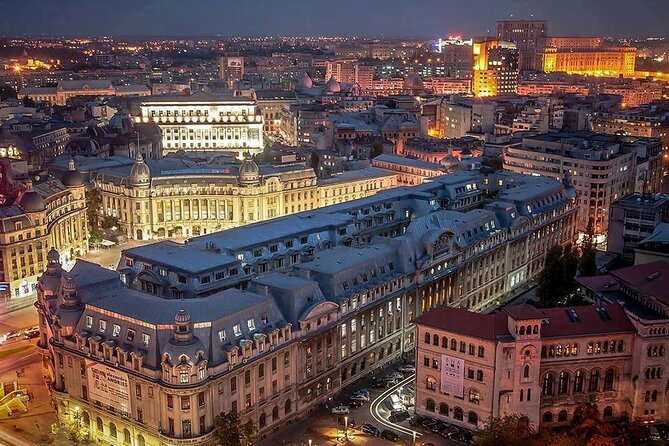
Your first stop is Revolution Square (Piața Revoluției), around 20 minutes. This is the place where Ceaușescu’s last speech on 21 December 1989 set off the popular revolt that led to the end of the communist regime. That makes this stop more than a landmark—it’s the start of the tour’s biggest storyline.
What makes Revolution Square powerful is that you can connect a single moment to the city’s shift afterward. As you look around, it helps to think of this as a “cause-and-effect” stop: a speech, a rupture, and then a new era. A good guide will help you tie what you see on the ground to that turning point without drowning you in extra names and dates.
Practical tip: give yourself a full minute or two before moving on. Try to take in the space first—then let the guide explain how people gathered and why this square became decisive.
Possible drawback: this kind of central political square can feel open and exposed. If the weather is windy or hot, you’ll feel it sooner than in the narrower Old Town streets later in the route.
Calea Victoriei: an avenue with a candle-lit origin story
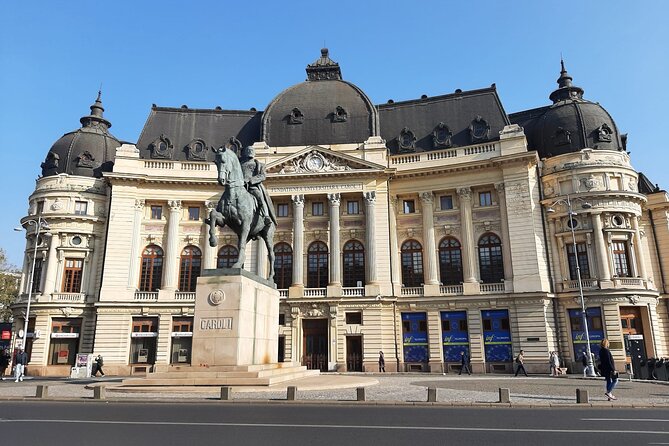
Next you head to Calea Victoriei (Victoria Avenue) for about 20 minutes. The tour frames it as one of Bucharest’s oldest roads and even points to a specific detail: it was the first street in Bucharest illuminated with candles during the night starting July 1814.
That candle detail is oddly satisfying because it takes you out of vague history. You’re not just hearing that the city “modernized”—you’re being shown the kind of change that actually improved daily life at a certain moment in time.
Today, this avenue is one of Bucharest’s most important streets. So you’re essentially doing two things at once: walking through a modern “main drag” while also imagining how different the city felt when light was limited to nighttime candles.
Practical tip: this is a great moment to ask questions about what you’re looking at in real time—architecture styles and street layouts. With a group of 10 or fewer, you’ll have less wait time for an answer.
University of Bucharest: a quick architectural pause
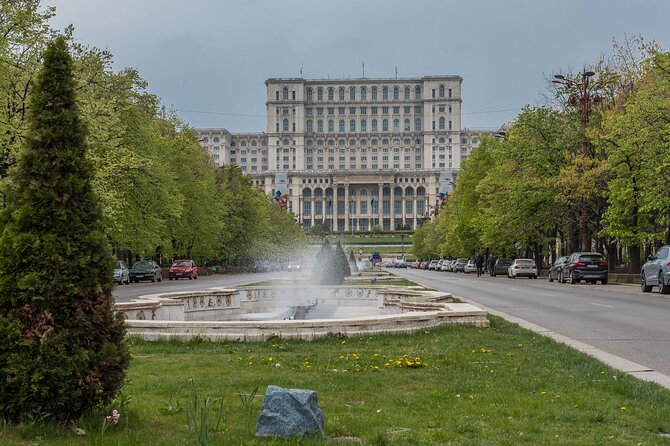
At the University of Bucharest you’ll spend around 10 minutes. This is one of those stops where the goal is to register the scale and character of a landmark building rather than to linger like you would in a museum.
Even in a short time, the university stop can help you understand Bucharest as a city with institutions that outlast political swings. You also get a visual contrast: after the revolution story and the grand avenue, you shift to something more academic and civic.
If you like quick hits: this is one of the easier stops to enjoy. If you hate rushing: treat the time here as a “glance and remember” moment, and save your deeper questions for the guide.
Macca Villacrosse Passage: a mini Vittorio-Emanuele moment
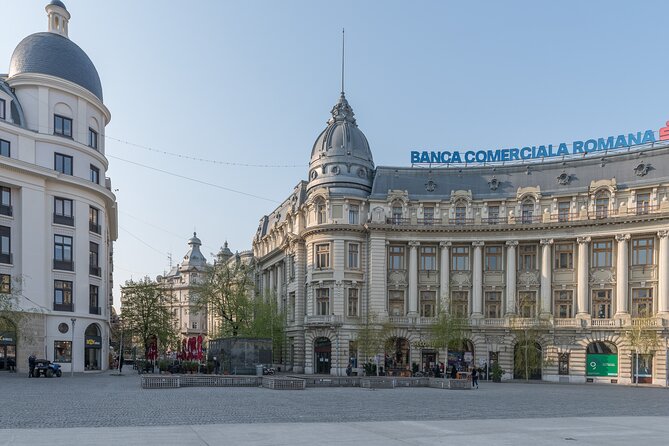
Next comes Macca Villacrosse Passage for about 10 minutes. The tour describes it as a mini Vittorio-Emanuele gallery in the Old Town, which gives you a helpful mental image: think of a covered-feeling passage with a strong sense of place, designed to make pedestrians linger and browse.
This is the kind of stop that works well in a walking tour because it slows you down without adding major route complexity. You get a change of scene—texture, angles, storefront rhythm, and the feeling of being inside the Old Town’s layout instead of just walking its edges.
Practical tip: keep your phone handy. This is a place where small perspective changes make photos look better, especially if the light is shifting outside.

Stavropoleos Monastery: 18th-century Eastern Orthodox calm
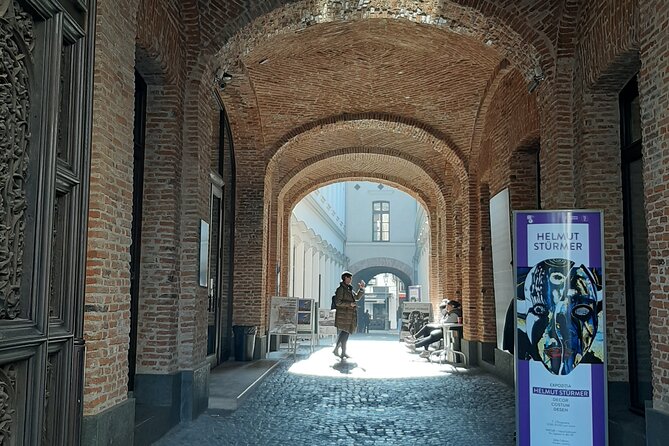
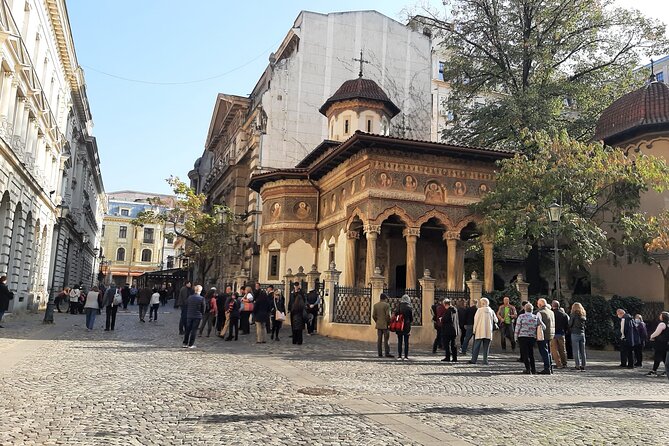
Your next stop is Stavropoleos Monastery, spending about 15 minutes. The tour notes that the church/monastery is an Eastern Orthodox site built in the 18th century by a Greek monk.
This is where the tour gives you a breather from civic squares and major avenues. A monastery stop works like a reset button: the guide can connect you to religious architecture and explain why this kind of building mattered, while you get a chance to slow your steps and notice details.
What I like about this inclusion: it balances the tour. Revolution Square is big and loud in meaning; Stavropoleos is quieter and more human-scale. Together, they show Bucharest isn’t only defined by major political events—it also preserves places people used for centuries.
Possible drawback: if it’s crowded or if access is limited at that moment, you may have less time to linger. In that case, focus on the feel of the space first, then read the guide’s context.
Hanul cu Tei and Manuc’s Inn: historic inns that still feel real
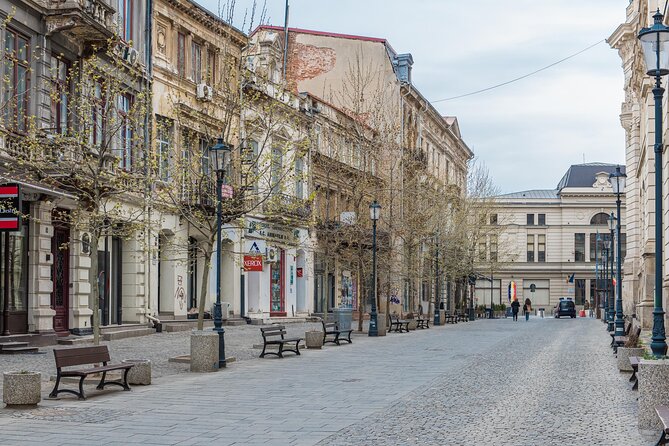
The route then turns toward Old Town commerce and heritage inns.
Hanul cu Tei (about 10 minutes)
Hanul cu Tei is described as the only historic inn in Bucharest that preserved its shape exactly as it was at its origins. That’s a strong promise—because so many historic buildings get patched, rebuilt, or “refreshed” until they feel less authentic.
Even if you’re not planning to eat or shop inside, it’s a rewarding stop because it’s architecture as evidence. It shows continuity: the kind of place travelers and locals once relied on continues to exist in its original form.
Manuc’s Inn (Hanul lui Manuc) (about 10 minutes)
Then you move to Manuc’s Inn (Hanul lui Manuc), about 10 minutes. Here the tour notes two big points: it’s the oldest operating hotel building in Bucharest, and it was also an important commercial complex in the middle of the 19th century.
This is the perfect pairing with Hanul cu Tei. One is about preserved shape; the other is about continuous use. If you’re thinking, wait, how can one building be both historic and still functioning? This stop is your answer.
Practical tip: if you’re hoping to use the buildings’ interiors (restrooms, small purchases, or just a look), be ready. One of the guide highlights was how well the guides knew the local spots and could direct you when you needed something practical, like a restroom while staying on schedule.
Piața Constituției: close to the Palace of Parliament
Finally, you finish at Piața Constituției, spending about 15 minutes. The tour frames this square as facing the Palace of Parliament, described as the second biggest administrative building in the world.
This ending works because it connects the earlier revolution setting to what came afterward in the city’s built form. You’re ending with a massive, symbolic government structure. Even if you don’t enter it, seeing it from outside can help you understand why this area became the center of modern state power.
Possible drawback: the Palace area can feel monumental and traffic-heavy depending on the time of day. If you’re sensitive to crowds or noise, arrive with the mindset that the goal is the view and the context—not quiet reflection.
Price and value: why $16.87 makes sense here
At $16.87 per person for about 3 hours, the value comes from two things: the route covers multiple major themes, and the tour includes admission where it matters as free for the stops listed. When most stops are free to enter, you’re paying mainly for interpretation, pacing, and the guide’s ability to connect the dots.
You also get a few practical “budget travelers” perks built in: the tour uses a mobile ticket, it’s offered in English, and the group is capped at 10 travelers. For a city like Bucharest—where things are spread out—a small-group walk like this often saves you time compared with stringing together sights on your own.
Two extra notes from the provided tour details:
- This tends to be booked ahead (an average of 18 days), so if your dates are fixed, don’t wait until the last minute.
- Good weather matters. If the forecast looks rough, have a backup plan or be ready to switch to another date if it’s offered.
Guide energy matters: Doina and Dorin as proof
The strongest pattern in the guide praise is how they act when you’re there in real life: friendly, enthusiastic, and ready to answer questions. Names like Doina and Dorin come up for going beyond the allocated time to show more of the town and share as much as possible.
That’s not just personality—it affects your experience. A guide who’s helpful with practical moments (like pointing you to a restroom) keeps the tour from turning into a rushed sprint. And because the itinerary includes several short stops, you want someone who can keep each one meaningful without eating up the schedule.
Is this the right Bucharest tour for you?
Book this if you want:
- a first-pass orientation of central Bucharest in a single morning,
- an easy walk with small-group pacing,
- a route that mixes political turning points, major streets, monastery calm, and Old Town inns.
You might choose something else if:
- you want long museum-style time at each stop,
- you prefer a slower, purely photo-focused pace with fewer explanations,
- you’re visiting during weather that’s often rainy, because the tour requires good conditions.
Should you book this Bucharest Step by Step tour?
Yes, if your goal is to understand the city without overplanning. This itinerary is built around strong anchors—Revolution Square, Calea Victoriei, Stavropoleos, and the Constitution Square/Palace of Parliament area—so you’ll leave with a mental map that makes future self-guided wandering easier.
If you’re on a tight schedule, the timing works. If you’re on a budget, the price is reasonable for a 3-hour guided walk with multiple stops and free admissions at the points listed. And if you like asking questions, the max 10-person group makes that feel realistic rather than theoretical.
FAQ
How long is the Bucharest Step by Step with a Local Guide tour?
It’s approximately 3 hours.
How much does the tour cost?
The price is $16.87 per person.
What language is the tour offered in?
The tour is offered in English.
Where does the tour start and end?
It starts at Piața Revoluției (Revolution Square) and ends at Piața Constituției (Constitution Square).
How many people are in the group?
The tour has a maximum of 10 travelers.
Is entry included for the stops?
The tour lists admissions as free for the stops included.
What if the weather is bad?
This experience requires good weather. If it’s canceled due to poor weather, you’ll be offered a different date or a full refund.