REVIEW · BUCHAREST
Best Walking Tour of Bucharest’s City Center – 2.5 hours
Book on Viator →Operated by Soca Tour · Bookable on Viator
One walk and Bucharest starts making sense. You get a history-rich city center route that’s far more human than a bus ride, and the small-group format helps the guide tailor answers. Big heads-up: there have been reports of guides not showing up or last-minute cancellations, so you’ll want to confirm the day of.
What I like most is the balance of big landmarks and close-up detail. You’ll also get entrances to key churches and monasteries, plus a souvenir—so your money goes toward experiences, not just standing near buildings.
In This Review
- Key things to know before you go
- Bucharest’s center, explained on foot (not over your head)
- Price and value: what you’re paying for at $54.77
- Where you meet and how the route finishes near the Athaeneum
- Stop 1: Romanian Athaeneum (the modern Romania symbol)
- Stop 2: Central University Library and the Carol I connection
- Memorialul Renașterii (the potato) and Revolution Square
- Universities’ Square, Kilometer 0 of democracy, and the walk into the Old Town
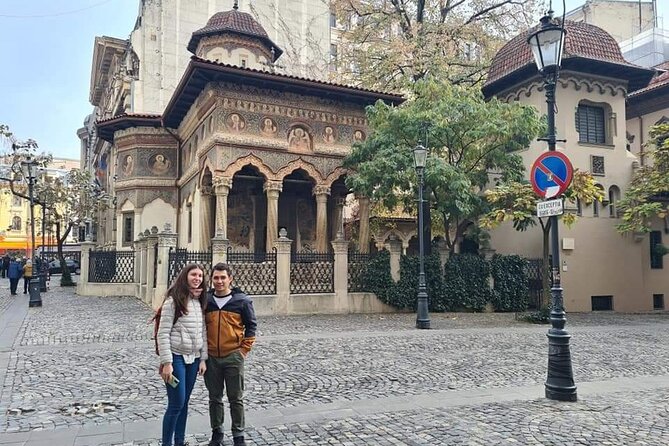
- Stavropoleos Monastery: byzantine spirituality in a small space
- Churches in the Old Town: Sf. Dumitru Poștă and St. Anthony (inside time)
- Curtea Veche: where Bucharest’s oldest layers show up
- Manuc’s Inn: history lesson plus a smart lunch plan
- Optional add-ons: Unirii Square views and the Patriarchal Cathedral
- The guides: where the magic actually happens (and a caution)
- Who this tour is best for
- Should you book this Bucharest city-center walking tour?
- FAQ
- How long is the Bucharest city-center walking tour?
- What does the tour cost?
- Where do I meet the guide, and where does the tour end?
- Is the tour offered in English?
- Are entrance tickets included?
- How big is the group?
- Can I cancel for a refund?
Key things to know before you go
A tight 2–3 hour loop through Bucharest’s core, designed to get your bearings fast
Byzantine churches you can enter (and not just look at from the sidewalk)
Revolution Square in plain language with stories tied to December 1989
A Royal-and-Modern timeline running from Carol I-era monuments to later events
Small group limit (up to 14) for a more personal pace
Reliability checks are smart since a few cancellations/no-shows have been reported
Bucharest’s center, explained on foot (not over your head)
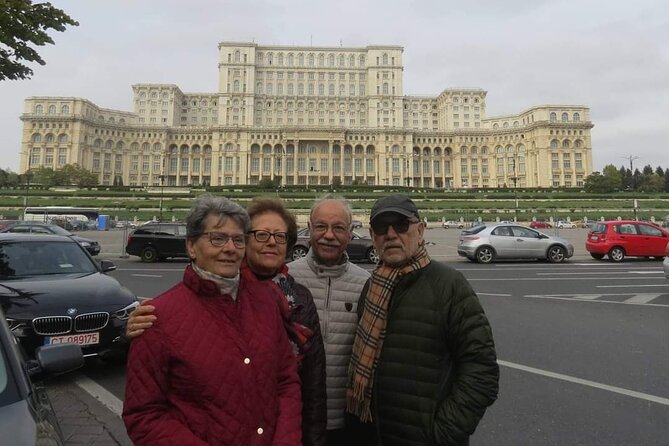
This is the kind of Bucharest walking tour that works best on Day 1—or any day you want clarity. The route is built around a simple idea: Bucharest’s most important ideas aren’t hidden in museums. They’re written into buildings, statues, squares, and street plans.
Instead of stopping at random pretty things, the guide moves you along a story line. You start with Romania’s modern symbol in the Romanian Athaeneum area, then connect to the older royal world and into the turn-of-the-century city. After that, the walk presses toward the Revolution era, where the guide explains what changed and why the square became a stage for young protesters.
And yes, you’ll walk. The reward is that you get to see how the city connects—how one square leads naturally to the next church, how the “big idea” monuments sit near the lived-in Old Town streets.
You can also read our reviews of more walking tours in Bucharest


Price and value: what you’re paying for at $54.77
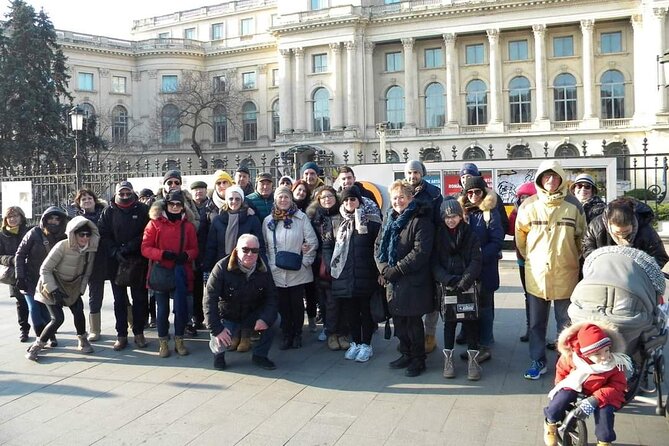
At $54.77 per person for roughly 2–3 hours, you’re paying for three things:
- A live English-speaking guide who links architecture to real people and events
- Stops where you get to enter churches/monasteries with admission included (per the tour inclusions)
- A smooth route through the center, with no need to plan every detail yourself
You’re not paying for a museum marathon. This tour is shorter on purpose. It’s designed for orientation and context: you’ll leave with a mental map of Bucharest’s “why,” not just a list of “what.”
One practical note: the Romanian Athaeneum stop is framed as a visit timed to whether it’s open, and the tour information says admission may not be included for that specific stop. So if you care about going inside the Athaeneum, treat that as a “check on the day” item.
Where you meet and how the route finishes near the Athaeneum
You start at Manuc’s Inn (Hanul lui Manuc), Str. Franceză 62. Your walk then ends at the Romanian Athaeneum area, near Strada Benjamin Franklin 1–3.
That end point matters more than it sounds. The Athaeneum is listed with opening hours that run 10:30 AM to 1:00 PM. If you want to maximize the chance of an interior visit, you’ll benefit from being early and keeping the tour’s timing in mind.
The tour also notes it’s near public transportation, which is helpful because you can link it with other plans in the Old Town afterward.
Stop 1: Romanian Athaeneum (the modern Romania symbol)
The Romanian Athaeneum is the headline act at the beginning. Expect fantastic French-style architecture, and a guide who explains why it became a symbol of modern Romania—not just a pretty facade.
Why this opening works: the Athaeneum gives you an entry point into Bucharest’s identity. It’s where the city’s ambitions show up in stone and detail. Starting here anchors the rest of your walk, because you’ll later connect the “modern” story to the royal era and then to the Revolution.
A key practical point: the stop is listed with 20 minutes, and the tour details note admission is not included for the Athaeneum stop. Still, the tour includes a visit if the building is open, so your best move is to ask on-site whether you’ll be going inside at that moment.
Stop 2: Central University Library and the Carol I connection
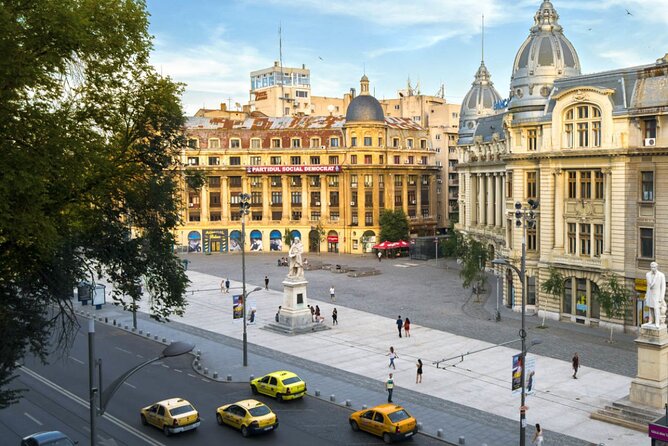
Next comes Biblioteca Centrală Universitară, a building tied to Carol I, the first Romanian king. The guide also points out the Carol equestrian statue in front of the library.
This stop is short, but it matters because it sets the tone for how Romanian leadership tried to shape public life through monuments: education, power, and national identity all show up in the built environment.
If you like your history with visuals, you’ll enjoy this one. It’s the kind of spot where the guide can point and connect dots quickly—why the building looks the way it does, and what it represented at the time.
You can also read our reviews of more city tours in Bucharest



Memorialul Renașterii (the potato) and Revolution Square
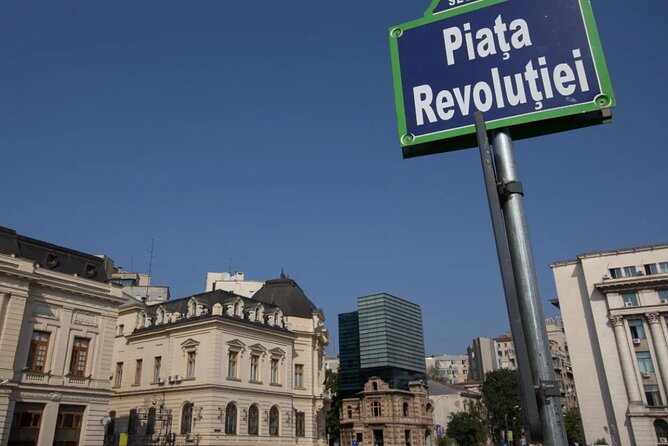
Then you hit Memorialul Renașterii, also nicknamed the potato. This obelisk was created after the December 1989 Revolution, and the guide uses it to explain the last days of communism in Romania.
You’re in the heart of Revolution Square, where young people fought against the regime. The guide also points to the fact that two major personalities captured and tortured by the communists remain in public memory through statues in the square.
Here’s why I think this stop is a strong mid-tour moment: you’re not just “learning dates.” You’re standing in the exact location where the public story was made physical. That changes how the history lands.
Universities’ Square, Kilometer 0 of democracy, and the walk into the Old Town

From there, the route continues to University Square (Universitatii). You’ll see headquarters of some famous Romanian universities and also Kilometer 0 of democracy, a symbolic marker for the Revolution of ’89.
The tour then shifts into a stroll through the Old Town. That matters because you start to feel Bucharest as a living city, not just a lineup of monuments.
A small detail to watch for: the tour info notes a stop related to a “Russia community” built in the early 20th century. Since no specific name is given in the tour details you provided, I’d treat it as an interpretive stop—something the guide explains on the spot.
Stavropoleos Monastery: byzantine spirituality in a small space
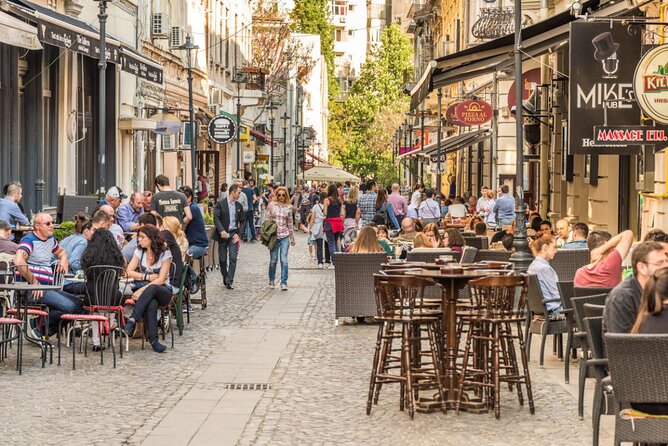
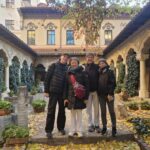
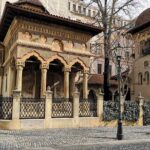
Now the tour leans into Byzantine architecture with Stavropoleos Monastery. The description calls it small and “coquet,” and you can also use it to understand the look of the painted monasteries from Bucovina.
This is one of the most satisfying stops because it’s compact. You can take it in without feeling rushed. And because the tour lists the monastery entrance as included, you’re not only looking—you’re stepping into the space the architecture was built for.
If you’re traveling with even a mild interest in religious art and architecture, this is where the tour starts to feel special. It’s easy to take churches for granted when you’re moving fast, but here the timing helps.
Churches in the Old Town: Sf. Dumitru Poștă and St. Anthony (inside time)
The route then includes two church stops that are worth paying attention to even if you’re not a church person.
Biserica Sf. Dumitru Poștă, nicknamed the White Princess of the Old Town, comes first. The tour highlights that this church has an interesting history, and the stop is brief but focused.
Then you move to Biserica Sfantul Anton – Curtea Veche (St. Anthony), where you’re encouraged to see the atmosphere and beauty inside. The tour also notes entrances in churches/monasteries as included—so this is another moment where you benefit from the tour’s “do more than just look” approach.
If you hate slow sightseeing, don’t worry: these are short stops. The guide time is concentrated on what you should actually look for.
Curtea Veche: where Bucharest’s oldest layers show up
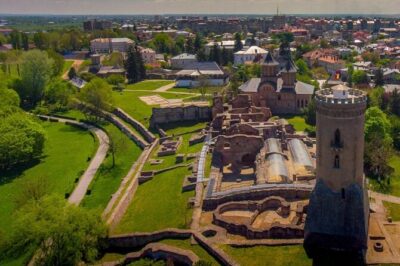
Muzeul Curtea Veche (Old Princely Court Museum) is another key pivot point. You’re in the oldest historic area tied to the medieval roots of Bucharest.
The tour description says the museum houses the oldest historical testimonies of Bucharest, dating from the 13th century, and that Wallachian rulers resided there starting in the 14th century. It also notes that Vlad the Impaler ruled Wallachia from here for a period.
This stop gives you a reality check: Bucharest didn’t begin with the modern monuments. It started with power centers and rulers, and those early layers shaped the later city.
If you’re thinking of doing more Old Town exploration after the tour, this is the stop that helps you understand why some streets feel more “old” than others.
Manuc’s Inn: history lesson plus a smart lunch plan
Your walk ends its core loop at Manuc’s Inn (Hanul lui Manuc), described as the oldest inn and restaurant in town.
The tour frames the inn’s story through the character of a wealthy, cunning boyar whose actions shocked the Russian and Ottoman empires. It also calls it a recommended place to book for lunch.
Even if you don’t eat there, keep this in mind: this inn is one of those Bucharest places that makes the city feel connected to real historic trade and travel patterns—not only royal or political drama.
Practical tip: if you want lunch right after the tour, consider trying to book ahead, since it’s being positioned as a go-to spot.
Optional add-ons: Unirii Square views and the Patriarchal Cathedral
Depending on time and your interest, the tour includes two optional pieces:
- A view area near Unirii Square, for a look from a distance
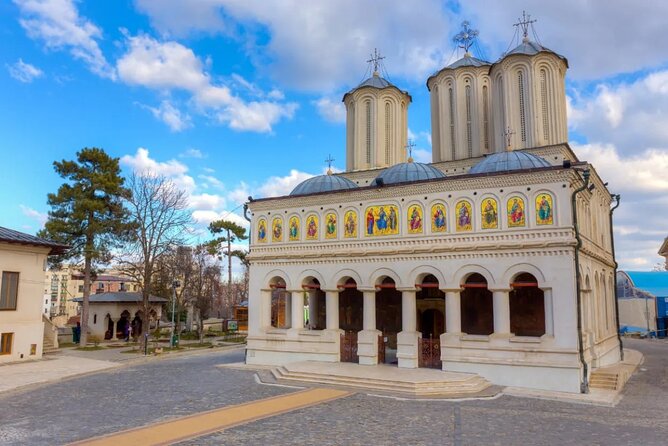
- The Patriarchal Cathedral, on a hill next to Unirii Square, with the chance to enter a sacred space full of paintings and decorations
These are “choose your own pace” items. If you’ve had enough walking, you can keep it simple and finish with the earlier highlights. If you still have energy, these optional stops can add a strong visual and spiritual finish.
The guides: where the magic actually happens (and a caution)
The best part of this tour—at least when it runs smoothly—is the storytelling. The tour format depends on the guide turning architecture into something you can picture: Carol I-era ambition becomes tied to the library and statues; monarchy becomes connected to symbols; the Revolution stops become more than a marker on a map.
People have specifically praised guides like Cristina, Maria, and Nicolae for being serious about culture and for sharing lots of anecdotes that make the walk feel alive rather than textbook. If you get a similarly strong guide, you’ll probably feel like Bucharest clicked into place.
Now, the caution. A small number of experiences have been described as unreliable, including cases where the guide didn’t show up and where cancellations came on short notice. To protect your vacation time, do two simple things:
- Double-check the confirmed start time close to departure
- Be ready with your contact information and an alternate plan if things seem off
That’s not meant to scare you. It’s just smart for any walking tour in any city.
Who this tour is best for
This works especially well if you:
- Want an easy first-day orientation in Bucharest’s center
- Like history that’s tied to what you can see right now (statues, churches, squares)
- Prefer walking over buses because you want to ask questions and linger just a bit when something clicks
- Want church/monastery entrances included, so you don’t waste time deciding on the spot
If you hate walking, if you’re short on time, or if you’re hoping for a museum-heavy day, this may feel too “city streets + key stops.” It’s built for focus, not everything.
Should you book this Bucharest city-center walking tour?
I’d book it if your goal is clarity—a strong first look at Bucharest with a guide who connects the monarchy, the Revolution era, and the Old Town’s religious art into one walkable story. The value is strongest when you’ll use the included entries and when you want that small-group pace.
I would also book it with one practical mindset: expect it to be as good as the guide, and make sure you’re set for the day. With a smooth start, it’s a great way to turn Bucharest into something you can recognize, not just remember.
If you want, tell me your travel month and whether you want more churches or more political history. I can suggest a simple plan for pairing this walk with the rest of your Bucharest day.
FAQ
How long is the Bucharest city-center walking tour?
The tour lasts about 2 to 3 hours.
What does the tour cost?
The price is $54.77 per person.
Where do I meet the guide, and where does the tour end?
You start at Manuc’s Inn (Hanul lui Manuc), Str. Franceză 62, and the tour ends at the Romanian Athaeneum, Strada Benjamin Franklin 1–3.
Is the tour offered in English?
Yes, it’s offered in English.
Are entrance tickets included?
Entrance tickets are included for churches and monasteries listed as St. Anthony, Stravropoleos Monastery, and St. Demeter Church. The Romanian Athaeneum stop notes admission may not be included if you’re visiting inside.
How big is the group?
The maximum group size is 14 travelers.
Can I cancel for a refund?
Yes. You can cancel for a full refund up to 24 hours in advance.